Newsletter Date: 4th February 2026
Issue: 01/26
Kia ora Team Bayview
A huge welcome back to the 2026 academic year. We have had a fabulous start to the year with lots of very happy learners and parents!
We have one new teacher joining us this year. We warmly welcome Daisy McDonald to our staff!
All our wonderful staff have already spent weeks preparing for the start of the year and have made a great start with our learners. Our organisation for this year is: (Please note the learning group your child is in)
|
Habitat
|
Year
|
Kaiako/Teacher
|
|
Phase 1
|
|
1
|
0/1
|
Kara Napier
|
|
2
|
0/1
|
Victoria Walsh
|
|
3
|
0/1
|
Alaica Ramphul
|
|
10
|
0/1
|
Shannon Corlett
|
|
6
|
2
|
Rhianon Pearce
|
|
8
|
2
|
TeAna Lambert
|
|
11
|
2
|
Adelaine Arias
|
|
12
|
3
|
Andy Samphanphorn
|
|
13
|
3
|
Megan McGuire
|
|
Phase 2
|
|
14
|
4
|
Katrina Cray
|
|
15
|
4
|
Sydney Malonzo
|
|
16
|
5/6
|
Janelle Staples
|
|
17
|
5
|
Jackie Terry
|
|
18
|
5
|
Min Davies
|
|
19
|
6
|
Nathan Hinton
|
|
20
|
6
|
Elleen Davids
|
|
Other Staff
|
|
Principal
|
Diane Raynes
|
|
DP
|
Shelley Matuku
|
|
AP
|
Alyssa Farrow
|
|
CRT
|
Sarah Fink
|
|
CRT
|
Tegan Cheeseman
|
|
Literacy support
|
Hayley Roberts
|
|
Maths support
|
Daisy McDonald
|
|
ESOL/ORS support
|
Bronnie Ryan
|
|
Teacher Aides
|
Angela Duncan
Katie Hearl
Larissa Latoa
Sifa Matasifa
Lisa Pulusi
|
|
Office manager
|
Shannon Sofaea
|
|
Bursar
|
LaiHar Lim
|
|
Caretaker
|
Erik Corbett
|
|
Gardener
|
Jane Gibbons
|
You can see we have changed our structure slightly moving into Phase groups (Phase 1 = Y0-3; Phase 2 = Y4-6)
Your child will also be allocated a house group. They will be placed in their house group by Shannon in the office at enrolment. Your entire family will be in the same house group. If you are unsure of which group they are in please ask your child’s teacher.
UNIFORM
Gosh, our learners look great in their uniform. Thank you to everyone who has ensured their children are in the correct school uniform to start the year. Please ensure all your child’s clothing is named with their first name and their surname so these can be returned if left around the school. The only jewellery permitted is stud earrings, a watch (not a smart watch as that is classified as a mobile phone), an upstander wristband, medic alert bracelet, pounamu necklace, or religious necklace i.e. crucifix. For safety reasons, we ask that all learners with long hair have it tied up while at school. Please also note that your child must wear a sunhat when they are playing outside during terms 1 and 4.
Please note the following which are NOT school uniform:
- Gumboots
- Crocs
- Jandals/sandals without a heel strap
- Old school uniform polos or jumpers
- Bike pants
- Jeans
If there is an issue with any of this please feel free to chat with your child’s teacher or a member of the leadership team.
LOST PROPERTY
We have moved the location of the lost property and this can now be found in the walkway leading from H3 and 4 to the COLA). You will have access to this out of school hours. Please name your child’s clothing as we are able to return lost items to them if you have named them! We have called this ‘Lost Lane’!
MOBILE PHONES/SMART WATCHES
It has always been a policy at Bayview School that any child that brings a mobile phone to school must hand it into the office in the morning and collect it at 3pm. Please note this also includes smart watches that send and receive messages and phone calls. Our learners do not use mobiles for their learning. If your child does not hand their mobile in and it gets broken or misplaced it will be the responsibility of you and your child. Please support us by reminding your child to hand their phone into the office when they arrive at school.
LONG BAY PICNIC
This year we are holding our Long Bay Picnic on Friday the 13th February. Please note there will be no one at school to supervise any learners who are not attending. If you have not yet signed a permission slip for your child to attend please do so as soon as possible.
ROAD SAFETY
Please use the pedestrian crossing if you are crossing Bayview Road. This is teaching your child how to cross a busy road safely. What you role model will be what your child does. Safety first! It is also essential that you park and stop your vehicle legally around the school. Do not park on the yellow lines, not even for a quick drop off. This is illegal and is dangerous for other children moving outside the school. If parking enforcement officers are about you could incur a fine and we really don’t want that to happen to you.
BELL TIMES
Our school bell times for 2026:
8.55am – everyone in classes ready for the day
9am – Learning begins
10.45am – First break play
11.10am – eating time
11.25 – Learning begins
1pm – Second break play
1.25pm – eating time
1.40pm – Learning time
3pm School finishes
3.10pm – patrols finish/everyone should have left the school grounds
ATTENDANCE
Attendance in schools has been a top priority for the government and they have brought in strict guidelines for every school to follow. I have attached our procedures for your reference. Please note the MOE does not condone holidays during term time. If a child has frequent unexplained absences or what is considered unjustified absence we must refer to the school truancy service. If you pick your child up frequently before 3pm this is considered an unjustified absence which will also trigger a truancy service referral. Frequent lateness to school is another trigger.
We know that a child learns the best when they attend school regularly and are at school from 9am – 3pm.
Our target for 2026 is: that 80% of students are present for more than 90% of the term.
If your child is sick please complete an absence form on our website to let the office know https://www.bayview.school.nz/report-an-absence/ . Alternatively you can leave a voice message on the answerphone.
YELLOW LEGGED HORNET ACTIVITY IN BAYVIEW/GLENFIELD
If you live in Bayview or Glenfield you will be aware that Yellow Legged Hornets have been found in the area. It is really important that we work together to eradicate this invasive pest. We can do this by regularly checking our properties for nests and informing MPI if something is found. I have enclosed some information at the bottom of the newsletter for your reference.
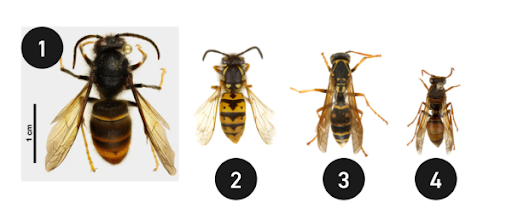
Know the difference between hornets and common wasps
1= Yellow legged hornet 2= German wasp 3= Asian paper wasp 4= Australian paper wasp
WELCOME TO OUR NEW LEARNERS
These wonderful learners have joined Bayview School:
Eira Baguilod, Malaikah Batoor
We hope you enjoy your time at Bayview School.
Term dates for 2026:
Term 1: 30 January – 2 April
Term 2: 20 April – 3 July
Term 3: 20 July – 25 September
Term 4: 12 October – 11 December
Di and Team Bayview Staff
2026 Dates for diaries
5 February – Maths Teacher Only Day (school is closed for instruction)
6 February – Waitangi Day holiday
13 February – Whole School Long Bay picnic
20 March – Kaipatiki Cluster Athletics Day
30 March – 1 April – Partnership meetings
2 April – End of term 1 school closes at 2pm
3 April – Good Friday holiday
20 April – Term 2 begins
Bayview School Strategic Plan for 2026
| |
|
AKO
|
HAUORA
|
KAUPAPA
|
|
STRATEGIC GOALS
|
|
Develop shared understandings of local curriculum to enhance clarity and shared expectations of quality practice.
|
The kura will review and refine hauora practices to support a learning focused culture.
|
Our kura will empower Māori learners to achieve successful educational outcomes as Māori.
|
|
Staff will be empowered to strengthen their own practice to meet the individual needs of learners.
|
Our kura will empower agentic learners with strong social and emotional intelligence.
|
|
EXPECTED OUTCOMES/SUCCESS STATEMENT
|
|
Stronger partnerships and enhanced curriculum provision, resulting in improved outcomes for all.
|
Ākonga will feel safe physically and emotionally.
|
Improved educational and cultural outcomes for Māori in partnership with students, whānau, hapu and iwi.
|
|
Ākonga will be free from racism, stigma, bullying and any other form of discrimination.
|
|
Te Tiriti principles will be woven through all systems and structures within the school.
|
|
Empowered and confident teachers using culturally responsive practices that foster hauora and success.
|
Empowered and confident ākonga who are able to display high levels of social and emotional intelligence.
|
| |
|
|
|
Attendance Procedures
|
|
Rationale
School leadership, boards, parents and the Ministry of Education all play key roles in supporting students to attend school – and addressing absence when it occurs. Lifting school attendance is our shared responsibility.
Every child has the right to an education.
|
|
Purposes:
To ensure:
- Every child is present at school to receive the best education.
|
|
Guidelines:
- Bayview School uses electronic registers and it is the teachers’ responsibility to ensure accurate attendance records are kept.
- Teachers must mark their register by 9.10am each morning and by 1.40pm each afternoon.
- If a teacher is absent, a paper copy of the register will be given to the reliever to fill out. The office will then transpose this data on to eTAP/HERO in both the morning and afternoon.
- The MOE will automatically upload attendance data every day from the school SMS.
- Attendance is checked by the office each morning at 9.10am.
- Office staff will contact the homes of any unexplained absentees, and record reasons given.
- If a parent contacts a teacher via Seesaw please ask that parent to complete an absence form from our website or to phone the office.
- If a child arrives at school late, they must inform the office by going there first.
- If a child is picked up early they must be signed out in the office. The office will give the parent a slip stating that the child has been signed out.
- If a parent comes to the class without a slip the teacher must ask them to go back to the office and follow the school procedures.
- If a child’s attendance becomes a concern, teachers should inform their Phase Group Leader. Contact should be made with Parents/Caregivers as early as possible. Major concerns should be referred to the Deputy or Associate Principal.
- Unsatisfactory attendance = >5 days absence in one term or >10 days absence over a year.
- Recording student attendance is a legal requirement, and as such must be accurate, and kept up to date as this information may be requested by the court.
|
|
Stepped Attendance Response – STAR Responding to all absences
The Stepped Attendance Response (STAR) sets expectations for school, student, parent/guardian, Ministry of Education and broader system responses to student absence. It provides a series of activities that should be considered when students meet absence thresholds. The actions taken will be tailored to the reasons for absence, for example a student with a chronic illness will require tailored supports for their education. The activities include considering prosecution for absences if appropriate support is offered and not taken up.
|
|
Schools:
• Assess attendance history of new students and share attendance history when students move between schools.
• Survey students and parents to support effective teaching practice and engagement
• School Leadership and Boards actively minimise disruptions to the school day and week e.g. use callback days, parent-teacher meetings held after school
• Support students to continue learning if unable to attend school every day, including using Ministry-approved well-being or transitional plans, or health schools where appropriate.
|
|
Less than 5 days absence in a School term
PARENTS/GUARDIANS
• Ensure student attends every day they are able
• Reinforce good attendance habits
• Support other parents to reinforce good attendance habits
• Open communication with the school
• Follow school attendance management plan and associated policies and processes
SCHOOLS
• Clear communication to parents on attendance expectations on enrolment, at the start of school year, and each term
• Communicate to parents what steps the school will take in the event their child is absent from school
• Communicate good attendance habits to students and parents
• Monitor attendance
• Communicate to parents about every absence
• Maintain contact details of parents
• Provide students with regular updates on their own attendance
• Report regularly to parents on attendance of their child
• Support students getting to school
• Use school level approaches to promote good social and learning environment
|
|
Up to 10 days absence in a school term
PARENTS/GUARDIANS
• Return student to regular attendance
• Contact school to discuss reasons for absence
• Support student to catch up on missed learning
• Engage in supports offered
SCHOOLS
• Send formal notification and contact parent/guardian to discuss reasons for absence
• Support students to catch up missed learning where required
• Use in-school resources as appropriate to remove barriers e.g. counselor, 2nd hand uniform shop, PB4L
|
|
Up to 15 days absence in a school term
PARENTS/GUARDIANS
• Return student to regular attendance
• Attend meeting at the school to analyse reasons for absence and to collaborate on a support plan
• Implement strategies at home
SCHOOLS
• Send escalated formal notification to parents
• Hold meeting to analyse reasons for absence and to collaborate on a support plan
• Develop and implement a plan tailored to the reasons and circumstances around the child’s absence
• Use in-school resources as appropriate to remove barriers and request support from Ministry or other agencies as needed
|
|
15 days or more absence in a school term
PARENTS/GUARDIANS
• Return student to regular attendance
• Engage in improvement plan
• Participate in regular meetings
SCHOOLS
• Send warning notice and make contact to arrange meeting with parents
• Escalate to multi-agency response
• Participate in multi-agency response
• Implement and monitor improvement plan
• Undertake school-led prosecution, or request Ministry-led prosecution, when considered appropriate if supports are offered and not taken up.
• Unenrol students who will not be returning to school
|
Yellow Legged Hornets – Ministry for Primary Industries advice
How you can help
- The best surveillance tool we have right now is for people to report any sightings of suspected hornets or hornet nests.
- When looking for hornets and their nests, check common nesting areas such as roof eaves of your house, sheltered entrances, wooden structures, carports, under wooden decks, sheds, and outbuildings.
- Also check your boat, caravan, or campervan before heading away with them to avoid moving nests around. When gardening, look out for signs of hornet activity and take care not to disturb their nests.
Video: Learn where to look for yellow-legged hornet nests – YouTube (1.45)
If you think you’ve found a nest
- Don’t attempt to remove or control a suspected hornet nest yourself, or spray a hornet or nest with insecticide. It is very important for Biosecurity New Zealand to know where the hornets are active. Any attempt to control them risks pushing them away, making it difficult to find them.
- We appreciate that taking photos can be hard, as the hornets are strong flyers, but images are the best method for us to assess the valuable observations made by the public.
If you think you have found a hornet or its nest, take a clear photo and report it:
- by calling our exotic pest and disease hotline on 0800 809 966
- by emailing us at info@mpi.govt.nz
- online at report.mpi.govt.nz – if you use this method, ensure that you select the ‘plants, spiders or insects’ option from the dropdown list.
Homemade traps
- We know many people want to help by setting their own traps. These may be effective in attracting hornets and other flying insects, but significant bycatch of other insects should be expected.
- We have created some easy-to-follow instructions for building a simple homemade trap.
How to make a homemade hornet trap – Fact sheet [PDF, 833 KB]
- A suggested bait formula to add to your trap is 400g of sugar, 10g of yeast, and 1 litre of water. You can also add 100ml of beer to this mixture.
- We recommend you change this bait every 3 weeks.
- It is important to closely monitor any homemade trap – check them at least once a week. It helps to be familiar with local wasp species that are not a concern in this response.
- If you make and install a homemade trap and believe you have caught a hornet, take a clear photograph and report it online or by calling 0800 809 966. Do not handle live hornets.